Government competence & business climate
60 pts apartCalifornia runs one of the world's largest economies but ranks near the bottom of business surveys and has had costly failures of execution, from $20 billion in pandemic unemployment fraud to long DMV lines. The candidates split over whether the fix is a more active, modernized government or a leaner one with far fewer regulations and a hunt for waste.
Last updated June 9, 2026
Can each make Sacramento actually deliver?
- Xavier Becerra (28/100) — Favors an active, modernized government: better management and technology over deregulation or shrinking the state.
- Steve Hilton (88/100) — Built almost entirely on deregulation, shrinking the bureaucracy, and a waste-and-fraud audit: the lean-government pole.
The situation in California
California's general fund has roughly doubled in size over the past decade, from about $113 billion in 2014–15 to about $229 billion in 2024–25, while its population stayed roughly flat. The state employs about 250,000 people, up more than 11% since 2011. By some measures the state does poorly by business. Chief Executive magazine's annual CEO survey has placed California in the bottom three for years, ranking it 50th in 2025, and the Tax Foundation ranks its tax system 48th of 50. Other rankings are kinder: CNBC placed California 22nd overall in 2025, lifted by its economy and tech sector, so the picture depends on what you measure. The execution failures are concrete. The unemployment agency paid out an estimated $20 billion in fraudulent pandemic claims, and state auditors found it dropped a key fraud safeguard.
- ~$229B
- State general fund, 2024–25
- ~250,000
- State employees
- Last (50th)
- CEO business-climate rank
- ~$20B
- Pandemic jobless fraud
Roughly double the ~$113 billion of 2014–15 in nominal dollars; consumer prices rose about a third over that decade and the population was roughly flat, so the real per-person increase is closer to half.
Full-time-equivalent state workers in 2024–25. The Legislative Analyst's Office counts growth of more than 11%, from about 226,000 in 2011–12 to more than 251,000 in 2022–23.
Chief Executive magazine's annual survey of CEOs has placed California in the bottom three for years; the Tax Foundation separately ranks its tax system 48th of 50.
State officials' estimate of fraudulent unemployment payments during the pandemic, as reported by NPR; the state auditor separately confirmed at least $10.4 billion in claims it later flagged as potentially fraudulent and found the agency had dropped a key identity safeguard.
California's state workforce grew about 11% from 2011 to 2022
Full-time-equivalent state employees, selected fiscal years
The Legislative Analyst's Office says the number of state employees rose from about 226,000 in 2011-12 to more than 251,000 in 2022-23. It also notes California's per-capita state workforce was just below the U.S. average in 2022: 7 state employees per 1,000 residents, compared with 7.3 nationally.
General Fund spending doubled in raw dollars; real per-resident growth was smaller
Index, 2014-15 = 100; nominal spending vs. inflation-adjusted spending per resident
Nominal General Fund expenditures rose from $113.4 billion in 2014-15 to $229.2 billion in 2024-25. After adjusting with CPI-U and California population, the increase is closer to 49% per resident. The spike in 2021-22 and drop afterward track one-time pandemic aid and capital-gains-driven revenue swings.
Pandemic jobless fraud dwarfed the money California recovered
Estimated stolen unemployment benefits vs. recovered funds, as reported in 2022 ($ billions)
State officials conservatively estimated about $20 billion in fraudulent pandemic unemployment payments, roughly 11% of COVID-era jobless benefits paid in California. NPR reported that the state had recovered $1.1 billion as of October 2022, mostly by freezing fraudulent debit-card balances. Later recoveries are not shown because this source gives the comparable stolen-and-recovered snapshot.
What's been tried
Recent state efforts have leaned on modernization rather than cuts. The DMV moved more than 90% of its transactions online to shorten lines. After the unemployment-fraud debacle, the Employment Development Department added identity verification and, by NPR's count, recovered more than a billion dollars of what was stolen. Hilton's campaign puts the number of state regulations on the books at about 420,000 and says the Legislature passed about 1,200 bills adding more regulation last year, figures the campaign cites rather than an official tally. There has been no broad regulatory rollback of the kind some other states have adopted.
Where they differ
The clearest contrasts, sub-issue by sub-issue.
| Sub-issue | Becerra (D) | Hilton (R) |
|---|---|---|
| Core diagnosis | Government can deliver if it's well run; bring executive experience and modernize agencies. | Government is bloated and corrupt; shrink it, audit it, and strip away regulations. |
| Regulation | Speed up permitting and benefits with technology; keep consumer and environmental rules. | Sunset the regulatory code so rules expire unless renewed; copy Idaho's deep cuts. |
| Waste & fraud | Audit every state AI system and add oversight; no Cal DOGE-style fraud office proposed. | Run Cal DOGE to expose waste and fraud he pegs in the hundreds of billions. |
| Taxes on business | Use state power to lower costs; has not proposed broad business-tax cuts. | No income tax under $100,000, a 7.5% flat rate above it, and lower small-business taxes. |
| State workforce | Give civil servants a voice as roles change; no pledge to cut headcount. | Cut bureaucratic bloat and consolidate agencies to reduce the workforce. |
Side by side
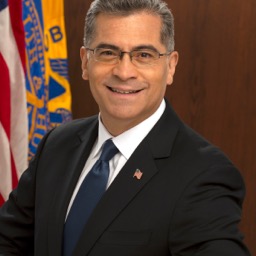 Xavier BecerraD · Democrat
Make government work better by managing it competently and modernizing it, not shrinking it.
Becerra runs on executive experience, arguing he managed a federal Department of Health and Human Services with a budget larger than California's. He would use technology, including AI, to speed permitting and cut DMV lines, audit state AI systems, and give civil servants a voice as their jobs change. He frames the state's job as using its power to lower costs and says he will make affordability a priority across every part of state government. He has not proposed broad cuts to the workforce or regulations.
- Runs on executive experience: 'knows how to manage a government as large as California'
- Use AI inside agencies for 'faster permitting, shorter lines at the DMV' and better benefits delivery
- Require an independent audit of every AI system a state agency deploys
- Give affected civil servants a voice as automation changes their roles
- Use state power to lower costs rather than cut services or staff
- Reported: Becerra has said little directly about California's business-climate rankings or whether he would cut any specific regulations; his economic message centers on lowering household costs. In NBC News reporting, some former Biden-administration colleagues questioned whether his record is the right fit, one saying it is 'not his skill set.'
Sources
- Campaign sitePriorities: Artificial Intelligence— Xavier Becerra for Governor (campaign site) · January 1, 2026
“faster permitting, shorter lines at the DMV”
Accessed June 8, 2026 - Campaign sitePriorities: Economy & Affordability— Xavier Becerra for Governor (campaign site) · January 1, 2026
“make affordability a top priority across every part of state government”
Accessed June 8, 2026 - News reportXavier Becerra faces pushback from Biden-era colleagues as he rises in California— NBC News · May 15, 2026
“not his skill set”
Accessed June 8, 2026 - News reportDemocrat Xavier Becerra leverages experience, immigrant roots in bid for California governor— Times of San Diego · May 29, 2026
“knows how to manage a government as large as California, I had to balance the budget of a federal Department of Health and Human Services”
Accessed June 8, 2026
 Steve HiltonR · Republican
Shrink and audit the state: sunset regulations, cut the bureaucracy, and chase waste with Cal DOGE.
Hilton calls California 'really badly governed' and makes lean government the center of his campaign. He would apply a regulatory sunset to the state's code so rules expire unless lawmakers explicitly renew them, citing Idaho's deep cuts, and introduce 'regulatory budgets' that force agencies to remove old rules before adding new ones. He runs an audit group he launched, Cal DOGE, that he says has found hundreds of billions in waste and fraud, and proposes 'permit paybacks' that refund fees when agencies miss deadlines. On taxes he pledges no income tax under $100,000, a 7.5% flat rate above it, and lower small-business taxes.
- 'Sunset our regulatory code, so regulations go away unless explicitly renewed'
- Introduce regulatory budgets: agencies must cut old rules before adding new ones
- Run Cal DOGE to expose waste and fraud he estimates in the hundreds of billions
- Require 'permit paybacks' that refund fees when agencies miss permitting deadlines
- No income tax under $100,000, a 7.5% flat rate above it, and lower small-business taxes
- Reported: Cal DOGE's waste-and-fraud totals are the campaign's own estimates and have not been independently audited. Its January 2026 launch put the exposure at about $250 billion, far larger than the roughly $20 billion in pandemic jobless fraud that state officials have estimated and partly confirmed.
- Reported: Hilton's tax and deregulation pledges would need legislative approval and, for major tax changes, likely a ballot measure; the campaign has not published a full estimate of the revenue they would cost.
Sources
- Candidate statementCAL DOGE Targets Corruption, Fraud and Waste & Will Drive Structural Government Reform in California— Steve Hilton for Governor (campaign site) · January 28, 2026
“CAL DOGE exists to end that system and replace it with accountability and reform”
Accessed June 8, 2026 - Campaign siteSteve Hilton for California Governor: official campaign site— Steve Hilton for Governor (campaign site) · January 1, 2026
“Sunset our regulatory code”
Accessed June 8, 2026 - News reportSteve Hilton on His Surprisingly Strong Bid for California Governor— TIME · May 30, 2026
“nowhere better than California, but we”
Accessed June 8, 2026
What changed
- added
Replaced the ordinal business-rank chart with measurable government-size and execution charts: workforce growth, normalized General Fund spending, and EDD fraud versus recovered funds.
- added
Initial build: sourced background on California's government size and business-climate rankings, plus Becerra's competence-and-modernization approach and Hilton's deregulate-and-audit approach.