Housing & homelessness
52 pts apartCalifornia has the nation's largest homeless population and some of its highest housing costs. The candidates diverge sharply on how far to rely on public funding and a 'Housing First' model versus deregulation, market-rate building, and enforcement- and treatment-first approaches.
Last updated June 9, 2026
How would each candidate tackle homelessness and the housing shortage?
- Xavier Becerra (30/100) — Leans on public investment, a continuous prevention fund, and Housing First, while also embracing fee and permitting reform to build more.
- Steve Hilton (82/100) — Enforcement-first on encampments, rejects Housing First, and relies on deregulation and market-rate supply.
The situation in California
California is home to roughly a quarter of everyone experiencing homelessness in the United States, and about two-thirds of its homeless residents are unsheltered, the highest unsheltered rate in the country. The state has spent tens of billions of dollars over the past several years, but a 2024 state audit found it had not consistently tracked where the money went or whether it worked. The 2025 federal count came in at about 182,000, down 2.8% from 2024 — the first decline in years.
- ~187,000
- Californians experiencing homelessness
- ~2 in 3
- Share who are unsheltered
- ~1 in 4
- Share of all U.S. homelessness
- $6.4 billion
- Proposition 1 behavioral-health bond
- 2024 state audit
- Accountability gap
January 2024 federal point-in-time count, the largest homeless population of any state.
About two-thirds sleep outside rather than in shelters, the highest unsheltered rate in the U.S.
Roughly a quarter of all unhoused Americans live in California.
2024 bond; the state projects ~6,800 residential treatment beds and ~26,700 outpatient slots when fully awarded (Governor's office figures).
Auditors found California had not consistently tracked its homelessness spending or whether programs worked.
California housing permits have hovered near 100,000 a year
New privately owned housing units authorized by permit, California, 2014-2025
Permits are not completed homes, but they are a consistent annual leading indicator of new supply. California authorized about 104,000 units in 2025, below the 2021-22 peak and far below the production pace implied by million-home campaign promises.
California's homeless count over time
HUD point-in-time count, total sheltered + unsheltered
Counts rose steadily through 2024, then fell 2.8% in 2025, the first decline in years. No full statewide count was conducted in 2021. 2025 figure per CalMatters.
California has the most homeless residents of any state
Total people experiencing homelessness by state, 2024
California and New York alone account for nearly half of everyone counted as homeless nationwide; no other state is close.
But per resident, California ranks behind several states
People experiencing homelessness per 10,000 residents, 2024 (states and D.C.)
Adjusted for population, California's rate (~48 per 10,000) trails Washington D.C., Hawaii, New York, Oregon and Vermont. The dashed line is the U.S. average, about 23.
Unsheltered vs. sheltered: California vs. U.S.
Share sleeping outside vs. in shelter (2024)
About two-thirds of California's homeless residents are unsheltered, nearly double the national rate of roughly one-third.
State homelessness funding is falling
State homelessness spending by fiscal year ($ billions)
As one-time pandemic-era funds expired, annual state homelessness spending fell sharply from its $6.9 billion peak. For 2026–27 the only major new state investment proposed is $500 million in HHAP grants — about half the prior round. (That HHAP-only figure is left off the bars above, which track total spending, so the measures stay comparable.)
What's been tried
Recent state efforts include the HHAP (HHAP) grant program, a 'Housing First' policy that prioritizes permanent housing without preconditions, and Proposition 1 (2024), a $6.4 billion behavioral-health bond for treatment beds and housing. State homelessness spending has fallen sharply from its peak as one-time pandemic-era funds expired. A 2024 state audit criticized weak outcome tracking; in response the Legislature attached stricter accountability conditions to later HHAP rounds.
Where they differ
The clearest contrasts, sub-issue by sub-issue.
| Sub-issue | Becerra (D) | Hilton (R) |
|---|---|---|
| Encampments | Opposes criminalizing unhoused people; offer support and shelter rather than arrest. | Enforce anti-camping laws; clear encampments first, then triage people into services. |
| Housing First | Keep Housing First, paired with behavioral-health and addiction treatment where needed. | End Housing First; redirect funding to sober, abstinence-based housing. |
| Building supply | Roughly double construction (1.5–2M homes); reform fees and unstick stalled units. | Build single-family homes on city outskirts; curb the CEQA lawsuits he blames for blocking housing. |
| Funding approach | Create the state's first continuous homelessness-prevention funding stream. | Pause and redirect existing funding pending a full review of past spending. |
| Accountability | Launch a public dashboard tracking the cost and outcomes of state-funded housing. | Demands a complete review of how past homelessness money was spent. |
Side by side
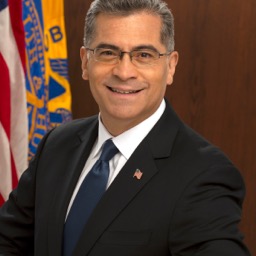 Xavier BecerraD · Democrat
Build aggressively, fund prevention, and treat homelessness as a need for support rather than a crime.
Becerra would declare a housing state of emergency on day one, aim to roughly double construction to 1.5–2 million new homes in a first term, and create California's first continuous funding stream for homelessness prevention. He backs a Housing First approach paired, where needed, with behavioral-health and addiction treatment, and opposes criminalizing people who are unhoused.
- Declare a state of emergency over the housing shortage as a first action
- Target 1.5–2 million new homes in a first term and 'unstick' ~40,000 stalled units
- Create the state's first continuous funding stream for homelessness prevention (e.g. rental assistance)
- Keep Housing First, paired where needed with behavioral-health and addiction treatment
- Launch a public dashboard tracking the cost and outcomes of state-funded housing
- Reported: California has averaged about 106,000 new homes a year under Gov. Newsom, so 1.5–2 million in a four-year term would mean a sharp step up. That target and the 40,000 'stuck' units are campaign pledges; actual output would depend on the Legislature, local governments, and the market.
Sources
- Campaign sitePriorities: Homelessness— Xavier Becerra for Governor (campaign site) · January 1, 2026Accessed June 7, 2026
- Campaign sitePriorities: Housing— Xavier Becerra for Governor (campaign site) · January 1, 2026Accessed June 7, 2026
- News reportHow will California's next governor handle homelessness?— CalMatters · May 6, 2026
“This is against the law, and the law needs to be enforced.”
Accessed June 7, 2026
 Steve HiltonR · Republican
Enforce anti-camping laws, end 'Housing First,' and redirect money to sober housing and treatment.
Hilton calls Housing First a 'complete disaster.' He would enforce laws against street camping (clearing encampments first, then triaging people into services) and redirect funding toward sober (abstinence-based) housing and expanded mental-health and addiction treatment. On supply, he favors building more single-family homes on the outskirts of cities and curbing the environmental lawsuits he blames for blocking housing.
- Enforce anti-camping laws: 'This is against the law, and the law needs to be enforced'
- Clear encampments first, then triage people into the services they need
- End 'Housing First'; redirect funding to sober, abstinence-based housing
- Expand mental-health and addiction treatment capacity
- Build more single-family homes on city outskirts; limit CEQA lawsuits he says 'block housing'
- Reported: Hilton's claim that ~70% of California environmental lawsuits are used to block housing is a campaign assertion and is not independently verified here.
- Reported: There is no statewide ban on street camping; whether encampments are illegal is currently up to each city. Enforcing it everywhere would require local action or new state law.
- Reported: Hilton has not said whether he would keep, change, or scrap existing state programs such as CARE Court.
Sources
- News reportHow will California's next governor handle homelessness?— CalMatters · May 6, 2026
“This is against the law, and the law needs to be enforced.”
Accessed June 7, 2026 - Campaign siteSteve Hilton for California Governor: official campaign site— Steve Hilton for Governor (campaign site) · January 1, 2026Accessed June 7, 2026
What changed
- added
Added a housing-production chart from Census building-permit data so the axis covers the housing shortage as well as homelessness.
- added
Initial V1 build: sourced background context plus Becerra and Hilton positions on housing and homelessness.